Most Counter-Strike 2 players check their stats after a match.
They look at:
-
K/D ratio
-
Headshot percentage
-
ADR
-
MVPs
Then they queue again.
The problem? Raw stats don’t tell you why you’re losing rounds — or how to fix it.
If you’re searching for a better CS2 stats page, what you actually want is something deeper:
-
A way to review your matches quickly
-
Jump directly to critical mistakes
-
Understand your decision-making
-
Get actionable feedback
That’s where 2D demo review and event-based statistical insights change everything.
Let’s break down how to use them to improve faster than your competition.
Why Traditional CS2 Stats Pages Aren’t Enough
Most stats platforms stop at surface-level metrics:
-
Rating
-
Aim score
-
Utility damage
-
Entry success
-
Clutch rate
These numbers are useful — but they’re descriptive, not corrective.
Example:
-
You see you died 9 times as first death.
-
You had 0.00 teammates flashed per flash.
-
Your trade attempts were low.
But what does that mean in actual gameplay?
Without context, stats are just numbers.
What you need is:
-
Visual context
-
Timestamped events
-
Direct access to critical rounds
-
Clear, actionable explanations
That’s where 2D demo review systems come in.
What Is 2D Demo Review in CS2?
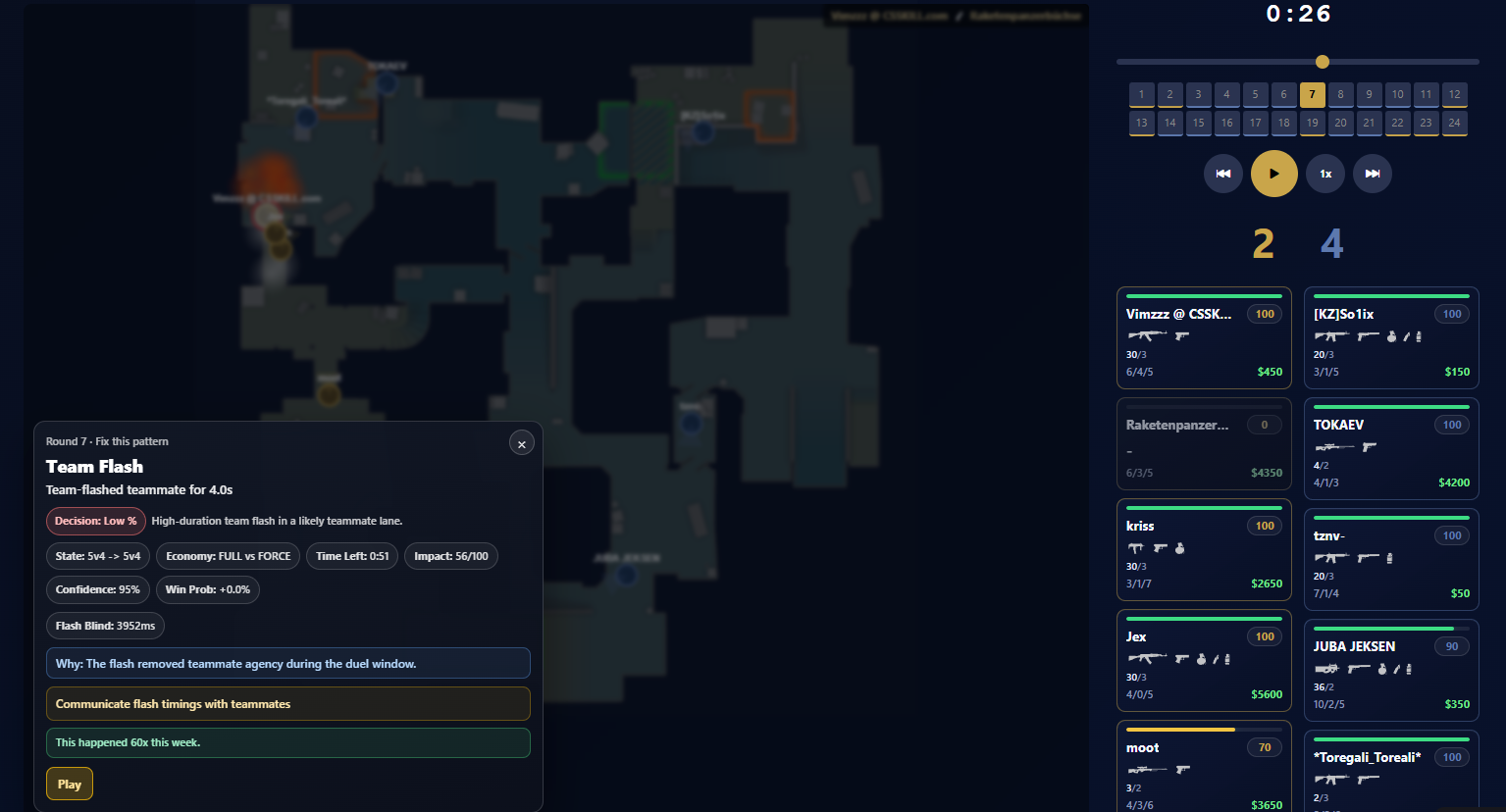
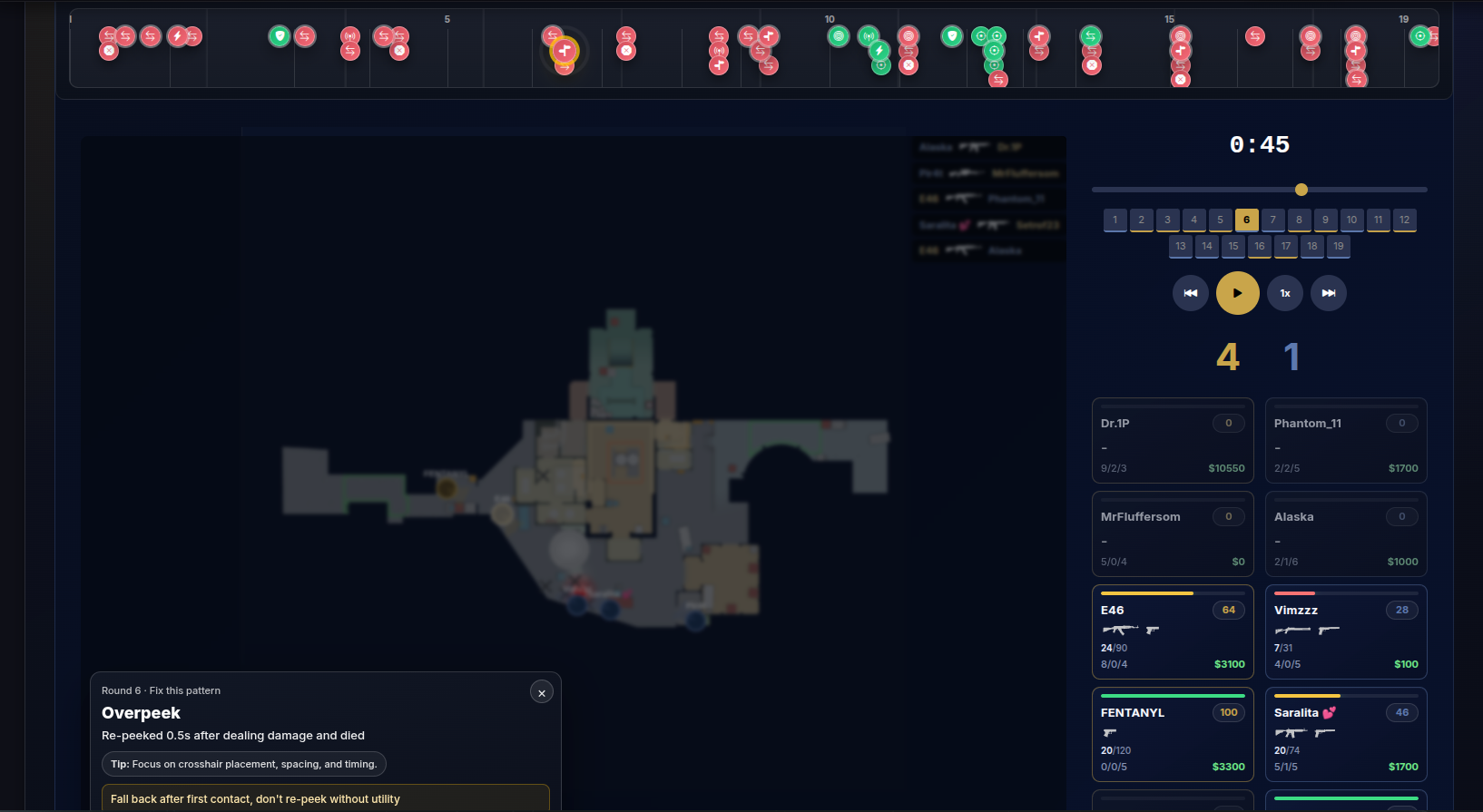
A 2D demo review system maps every player position, kill, utility usage, and event directly onto the map timeline.
Instead of watching a full 35-minute demo in-game, you get:
-
A top-down tactical view
-
Event markers per round
-
Kill trades visualized
-
Flash effectiveness tracked
-
Position heatmaps
-
Round-by-round breakdown
And most importantly:
👉 You can jump directly to the exact second where something important happened.
Jump Directly to Critical Moments
Imagine finishing a match and instantly seeing:
-
❌ 44 “Needs Work” events
-
⚪ 0 Neutral
-
✅ 12 “Best” moments
Now instead of rewatching everything, you click:
-
“Untraded death – Round 6”
-
“Missed trade opportunity – Round 10”
-
“Bad flash – Round 14”
-
“Trade kill – Round 14 (Good)”
You instantly jump to that moment.
This is how improvement accelerates.
Because now you're not guessing.
You're reviewing:
-
Exact positioning
-
Timing of your peek
-
Teammate spacing
-
Utility impact
-
Trade windows
Actionable Feedback > Raw Data
A good CS2 stats page shouldn’t just tell you:
“Trade attempts: 6”
It should tell you:
“You had 4 opportunities to trade within 3 seconds but did not attempt a refrag.”
Or:
“You died alone without a teammate within 800 units 7 times.”
Or:
“You used 3 flashes that hit teammates but created no enemy disadvantage.”
That’s actionable.
Now you know:
-
You’re overpeeking.
-
You’re not spacing properly.
-
You’re mistiming executes.
-
You’re not playing trade distance.
How to Use Statistical Insights to Improve Your Rank
Let’s break down how to actually use this data.
1. First Death Analysis
If your CS2 stats page shows:
-
High first death rate
-
Low trade support
-
High impact rounds when alive
Your issue isn’t aim.
It’s positioning and patience.
Fix:
-
Avoid dry peeks without utility.
-
Play tighter to teammates early round.
-
Stop contesting mid alone.
2. Trade Efficiency
Modern demo analytics can track:
-
Trade attempts within X seconds
-
Successful trade kills
-
Missed refrag windows
If you’re not trading:
-
You’re playing too far from teammates.
-
You’re late to react.
-
You’re not anticipating contact.
Improvement here alone can add rounds per half.
3. Utility Effectiveness
Instead of just “Utility Damage: 142”
Look at:
-
Flashes leading to kills
-
Teammates blinded
-
Smoke timing
-
Molotov delay value
Example actionable insight:
“You threw 4 defensive smokes after the enemy had already crossed.”
That’s not aim. That’s timing.
4. Clutch Context
A clutch loss isn’t always bad.
But if analytics show:
-
Poor repositioning after first kill
-
Repeating same angle
-
Low bomb tap reaction time
Now you can practice specific scenarios.
Heatmaps and Positioning Patterns
One of the most powerful features of 2D demo systems is positional heatmaps.
Over time, you can see:
-
Where you die most
-
Where you get entries
-
Which bombsites you avoid
-
Which areas you overpeek
This transforms improvement from “play better” into:
-
“Stop fighting A Ramp alone”
-
“You never contest Banana early”
-
“You rotate too slow from B”
Patterns win games.
Round Timeline Intelligence
A timeline-based breakdown lets you see momentum swings:
-
Consecutive bad rounds
-
Economy mismanagement
-
Force buy losses
-
Lost anti-ecos
You stop thinking:
“We just got unlucky.”
And start seeing:
“We lost 4 rounds because of early map control mistakes.”
From CS2 Stats Page to Improvement Engine
Here’s how to use advanced match analytics correctly:
After Every Match:
-
Review first deaths.
-
Review missed trades.
-
Check worst round rating.
-
Watch 3 worst decisions.
-
Watch 3 best plays.
-
Identify one improvement focus.
Not 10 things.
One.
That’s how improvement compounds.
Why 2D Demo Review Beats Watching Full Demos
Watching full demos is slow.
You:
-
Skip around randomly.
-
Forget why you’re watching.
-
Miss key mistakes.
A structured stats + demo review system:
-
Highlights critical mistakes.
-
Removes noise.
-
Focuses on decision-making.
-
Saves time.
Instead of 40 minutes per demo, you review your match in 5–10 minutes.
That’s scalable improvement.
What to Look for in a Good CS2 Stats Platform
If you’re searching for:
-
“Best CS2 stats page”
-
“CS2 match analysis”
-
“CS2 demo review tool”
-
“CS2 performance breakdown”
-
“How to improve in CS2”
Make sure the platform includes:
-
2D replay visualization
-
Timestamped event tagging
-
Trade detection
-
Utility impact scoring
-
Heatmaps
-
Round timeline breakdown
-
Player impact scoring
-
Actionable feedback labels (Best / Needs Work)
Without those, you’re just looking at numbers.
The Competitive Edge
Here’s the reality:
Most players rely on feeling.
High-level players rely on feedback loops.
A structured review system turns every match into:
-
Data
-
Context
-
Insight
-
Adjustment
And that’s how you climb.
Whether you’re grinding Premier, Faceit, or ESEA — players who analyze correctly improve dramatically faster.
Final Thoughts
A real CS2 stats page shouldn’t just tell you what happened.
It should show you:
-
Why it happened.
-
Where it happened.
-
How to fix it.
-
And how to avoid repeating it.
2D demo review + actionable insights is the evolution of match analysis.
If you’re serious about improving in Counter-Strike 2, stop just checking stats.
Start reviewing decisions. That’s where ranks are won.